Monday, December 7, 2015

Customer PII - Facebook Messenger

Facebook Messenger Customer PII 

PII, or personally identifiable information, is the security of data and transactions as well as the protection of intellectual property online. Privacy is hard to come by in the digital world today, and is something people take very seriously when using instant messaging programs.


Facebook has always been known as a platform where almost all of your information is public, but how does it messenger stack up? Apparently it's not as safe as we might have imagined, which is not much of a surprise knowing its part of Facebook.

Facebook Privacy: Safe or Not?

It was revealed by a coder in a blog post that a CIA-funded company called Recorded Future appears to be scanning private chat messages in Facebook. The blog later on concluded that the so-called "Facebook privacy" does not really exist.

Recorded Future is an American-Swedish firm that deals with identifying real-time online risks through web-based source collecting and analyzing. Knowing that the firm had also accessed a link on Facebook chat, which is deemed as a secure channel for sending private messages, had somehow brought back the question on how Facebook handles privacy.
In light of this information, it can be easily concluded that Facebook is not handling customer PII very well and to the best of their ability, especially when many people thought Facebook Messenger was secure.

A main element of proper PII is the ability of a business to assure its customers that their data and information are safe, especially in today's world where consumer power and access to information on the internet is at its peak and Facebook would be wise to take that in to account in the future.

Facebook Privacy Efforts

I believe Facebook is not doing enough in order to protect and secure customer PII. As a large company that has been around for a while, it has developed trust among its users but secretly gathers and stores information on their private chats without disclosing it. Facebook has been known to usually guarantee their customers one thing but eventually reveal that they did not stay true to their promise. This is one of the aspects of their company that they need to work on.

Trust is important in any business and an image of a trustworthy company can sometimes cause people to drop their guard.

In the past, Facebook has been known for doing research on their consumers in secret and gathering information on them as well. It would be beneficial for the company to disclose information on their activities to the customers to keep them informed. They could also send requests to customers who would like to volunteer for their surveys and information gathering, as long as they refrain from acting in secret.


Blog Analytics

The overall analytics since my blog started has been a very interesting set of results. When checking  Blogger and Google Analytics, it shows a decrease in views and comments since the beginning. The earlier posts have the most page views and a few comments. The last 3 posts have been at an all time low in terms of page counts and comments. Blogger shows a vast drop in people coming in and viewing / interacting with the blog. This is most likely because the first posts were quick analyses of all three companies with the most information readily available. As the posts went on, they focus on specific companies and very specific topics that people most likely are not interested in.

Differences in Blogger vs Google Analytics

The difference between Blogger and Google Analytics is the amount of viewers and newcomers that are being shown in the statistics results. According to Blogger, the last 3 posts have on average 10-12 people while Google Analytics shows about 20-30. 

The most interesting statistic is that Blogger shows a total of 81 page views, while Google Analytics shows 495 total page views with 85% being new visitors and 15% returning. This is a really vast difference and a large difference of traffic, but both still show the loss of traffic over the past months.


Traffic, Popularity, Improvement

Most of my traffic is coming from the US but several noticeable percentages are coming from Latin America and Canada. I feel that an improvement in the title of the blog and applying a less essay-oriented tone would be of great help and cause an increase of traffic in the future. The traffic is probably coming from these areas because it is a topic relevant to North America as Facebook Messenger and WhatsApp are widely known and used across the whole continent. These topics and businesses directly impact or connect to everyone from where the traffic is coming from.

The most popular post was the first one most likely because it is the beginning introduction to all the businesses and has the most quick information about all 3 without going very in-depth solely on one.

To improve the reach of my blog in the future I would have to focus on a very interesting topic to a large demographic, especially to people my age. A strategy would be to begin to promote it on my social media platforms and ultimately spread awareness by increasing my online presence

Works Cited
Trent, K. (2015, April 14). Recorded Future and Facebook Chat Messages. Retrieved December 6, 2015, from https://www.recordedfuture.com/facebook-chat-messages/

Webber, M. (2015, May 14). Naked Security. Retrieved December 6, 2015, from https://nakedsecurity.sophos.com/2014/08/12/why-the-facebook-messenger-app-is-not-the-privacy-nightmare-people-think-it-is/

Tuesday, December 1, 2015

Online Presence: Line Messenger

Online Presence : Line Messenger

In this blog I will be discussing the overall online presence from Line Messenger through their website and mobile presence.

Line Messenger's online presence at a glance is very strong. As one of Asia's top grossing messaging apps, it has a strong enough presence to be able to acquire this top position and maintain it as well. Due to Line being a messenger app in nature, it thrives off mobile devices. Its main purpose is to be used on the go and to even make free calls when in connection with wifi. This is not to say that their website is weak, they still have a desktop app as well where you can chat from your computer's big screen at home.

Line's ease of access stems off of its great presence. Line has a great website with proper adherence to general good website design principles / guidelines.


As seen on the picture to the left, the website is not cluttered and offers a very similar feel of being in a showroom (like an Apple store) as you scroll down the page and view their different features easily. The site has their most important features and information immediately given to you on the first page and their call to action buttons as well.


Line has a strong presence in the mobile realm, and their sites and presence on mobile devices are well crafted as well. The mobile applications in the store are easy to find. Through the mobile website, you can be redirected in seconds to the app store to find the Line Messenger app. Once downloaded, within the app, you can find their add on apps such as games very easily too. Line also uses good use of advertising as they promote their games on a well crafted banner on the main site showcasing their biggest game. The game section on the website is on the same section as the download button. Their mobile applications are very easy to find and to access.

Thoughts

As an actual user of Line Messenger I would rate their customer experience a 9 out of 10 in overall satisfaction and factoring the ease of access to all of Line's features.

A suggestion for Line's website would be to increase conversions and possibly ease the process of acquiring customers even further, is to emphasize more on the download button. The only slight problem is the top header with all the different actions. The most important button is the 'Download' option and would be great if it was highlighted or surrounded in a glowing / attractive box.

In general, Line's websites both on mobile and online are very clean and very easy to navigate. They have proper links to everything and very immediate information on everything while offering you the option of just skipping straight to the download page.

Google Analytics

Since the launch of my blog several months ago, there has been slight increases in today's statistics. The amount of page views has gone up with every post but in very small quantities, with less and less every blog post. Most of my traffic is coming from the US but several noticeable percentages are coming from Latin America and Canada. I feel that an improvement in the title of the blog and applying a less essay-oriented tone would be of great help and cause an increase of traffic in the future.

Works Cited

Tanada, H. (2014, October 8). LINE : Free Calls & Messages. Retrieved November 15, 2015, from http://line.me/en/


Shu, C. (2015, January 8). Line Messenger Releases Line Here, Its New Location-Sharing App. Retrieved November 15, 2015, from http://techcrunch.com/2015/08/20/line-here-you-go/

Friday, November 20, 2015

IAB

This blog post is about advertising and how it differs between mobile sites and normal online websites


To start off, the test begins by doing a search for a site on both a mobile device and on a computer. This was done for two different websites.

Results: 

After viewing the same site twice on two different platforms I found a very interesting set of results.
The first website, which was a blog about Facebook Chat, had about 3 ads that were in plain sight immediately around the borders. Surprisingly, the mobile site on the iPhone had no advertising anywhere! 

Mobile-Advertising-vs-Online-Advertising
The second site, which was a Line Messenger news website, had completely different results. The normal site had about 5 different ads this time across the page when scrolled. These ads were scattered across the page and in their own respective space on the sides or empty parts where they did not block any text or links. On the contrary, the mobile site had an immediate pop up as soon as the site was accessed. This pop up was slow to load and took the entire screen space requiring a forced exit to proceed to the page's content.

While these sites ranged from few clever positioned ads to terribly annoying pop up ads, they all still followed proper guidelines from IAB. None of these used Mobile Rising Stars.

Effective?

These ads both ranged from effective and ineffective. It is easy to guess that the mobile site with the full screen pop up was ineffective. The pop up stops the forward motion of a person, and in a society where technology consumes a lot of our time, time has become valuable. People do not like to put more time than they have to in a site, in fact many people end up quitting their search of site surfing after these pesky pop ups come out. A great example is people who click links on Facebook from other people. These people barely have an interest in the content and usually don't click through. For those who do: you could say they are hanging on by a thread and any small mistake, like a pop up ad, will totally cut the thread of their interest and have them exit the page.


The ads that are effective, like Facebook Chat's site, use a small space on sides of pages that are not in the way of a person's motion. They are positioned to be totally optional and respect a person's choice in whether they should click or not. These ads are not video ads as well, they are direct pictures with text promoting a service or product instantly, and look well crafted and attractive.

On the mobile sites, the site that chose to use less ads were also more effective. Instead of spamming the page with ads. the first site was effective in providing even less ads than the original website. This ensured that the finite space in the small screen was taken up in majority by the content itself. 

Potential strategy


The potential steps for video and online advertising these two messaging companies can take to reinforce their brand are very few, but vital. These companies need to select a key want or need from their consumers and address / reinforce it in their promotional video. Both of these companies prosper differently from the use of online advertising. I believe these companies should create strategic online advertising based on geographic location.

For Line, they are much less popular than other services in their industry, especially in the US. Therefore, online advertising in the US through sites should be increased, while maintaining their advertisement in Asia to a minimum.

On the contrary, Facebook chat is very worldwide as it stems from Facebook, but it could still a boost in advertising in other countries such as Japan and Korea that are more dominated by their competitor services.

Works Cited

Kent, J. (2015, March 8). Difference in Advertising. Retrieved November 16, 2015, from http://www.forbes.com/sites/robertwynne/2014/07/08/the-real-difference-between-pr-and-advertising-credibility

Kling, K. (2014, July 25). Mobile Advertising vs. Online Advertising - FunMobility Blog. Retrieved November 18, 2015, from http://blog.funmobility.com/2014/07/25/mobile-advertising-vs-online-advertising/

Monday, November 2, 2015

Facebook Messenger - Doing it right

Facebook Messenger Website


In this blog post I will be focusing on Facebook Messenger and talk about its organic search ranks as well as its social media presence.

The Company's Organic Search

Source: Google
Facebook is a major player in the social media industry and everybody knows that. The company is very large, well known, and a part of more than one industry. In terms of social media and rankings, Facebook stands at the top of all organic searches. It is something that, based off popularity and a large customer base, has become a very strong brand image with millions of searches on Google. Since Facebook Messenger is a strong asset from Facebook, and also carries its brand in the title, it has acquired a strong recognition and rank. When searched in the Appstore, it is at the top of the ranks for free apps downloaded. In Google, any keyword mentioning messaging brings up the company as well.

Social Media Presence
Source: IBIS World
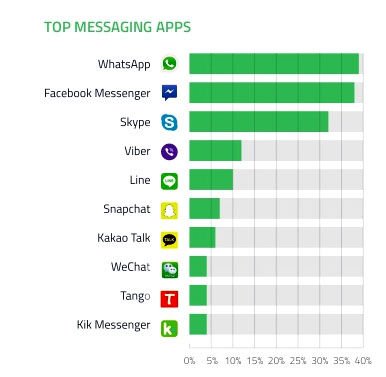
Facebook Messenger's presence is strong and their market share is second to WhatsApp. In a modern society where instant messaging is important for global communication and market entrance difficulty is high, Facebook Messenger has a great position. Across the world, Facebook is recognized as the biggest social media platform and Facebook Messenger is considered an extension of Facebook. Nowadays, having a Facebook is more than just a luxury, it is a necessity and a great tool for global networking so every single account on Facebook has access to the messenger and therefore its presence is excellent.


Improvements
In terms of improvements: there really is little room for change to improve. Facebook Messenger already benefits from being able to be used in Facebook itself, but even has a high ranked stand alone website for purely messaging. Facebook Messenger is definitely extremely effective in marketing and with a natural high ranking as well as paid, they are at the top of every page and app store. A possibility for improvement is investing in more keywords to increase and widen the variety of different words that can trigger the company to show up, The company runs a tight ship and is expected no less from something out of Facebook. The company has high paid and organic ranks keeping it on top of a dominated industry.


Keywords
Keywords are great tools for finding a company or a product when searching on a search engine with specific or lack of specific words. For a company to have a successful influx of customers and establishing a strong rank in the search engine world, they must choose the best keywords that they think people will most type for that industry. For Facebook, any keyword involving social media is vital and currently always points to Facebook as the primary page. For Facebook Messenger it is a little more diverse. It requires a few more specific keywords such as: messaging, instant message, online messaging, messenger service.

Works Cited


Trent, D. (2015, August 12). IBIS World Social Networking. Retrieved October 29, 2015, from http://clients1.ibisworld.com/reports/us/industry/default.aspx?entid=4574

Zuckerberg, M. (2015, March 4). Business on Messenger. Retrieved October 29, 2015, from https://www.messenger.com/business

Thursday, October 15, 2015

Analyzing Alerts and Promotions

Analyzing Alerts and Promotions - Facebook Chat, WhatsApp, Line Messenger

After following these three companies and receiving Google Alerts / emails about them, I have deduced that they are using proper direct marketing and email design principles to attract my attention and provide me with the information / news I need.

Email Design
Source: Google

The emails are predominantly well constructed in terms of email design, they adhere to many of the elements that make an email visible and attractive. The fact that I have chosen to opt-in and continue to do so (as a person who religiously chooses to not receive and follow emails) shows that they are doing a great job on their designing and delivery.

The Google Alerts emails are very numerous and generated a lot of traffic in my email making it hard to sort, but in terms of the email themselves they almost all have compelling content and very interesting offers and promotions that I never imagined.

 At first glance, the emails display decent subject lines but excellent preheaders to let me know quickly if the email is even worth opening, or what I can expect after opening it. These alerts are great and although high in numbers, give me the option of always stop receiving them which is really useful.

Marketing 

In terms of the content and how they used proper marketing tools, they also fulfilled various elements of good marketing that I caught on to. The content itself is very relevant to the information I need to find with steady updates that seem to know every little thing about the company and what they are doing. Most of these emails weren't thoroughly read but the majority were still opened and given a glance, which still elicited a course of action from myself (I commend you!). There was a couple of emails with very fun content as well as opposed to strictly news and straight on info-type.

Many of these emails had good click through rates and also made me feel like an active partner who receives relevant emails from a provider. In regards to the CAN-SPAM act: there is not a single email with content irrelevant or with malicious intent such as phishing. They all adhere to the principles of the act and have no misleading or deceptive content.

Source: Google
Changes?

  • Reduce quantity in general
  • Increase alerts on interesting updates such as features
  • Reduce alerts on financials / scandal type news

A/B Testing - 2 elements

  • Different Subject Lines - See if attraction will change or if it will only derail it
  • One email displayed at a time after clicking it - versus a whole list of past emails and alerts from past days


Internet I's - Interactive. Information-Driven. Immediate. Involving.

For Line Messenger's website:

In terms of interactivity the website is not very interactive and has very few clicking points. For example, as shown in the image to the right, there are several pictures showing the many features and more if you scroll down, but no option to click or learn more about the features on a new page.
Line Website

The website is very well designed, informative and easy to learn about the product and its many features at a glance. Immediately, the website is very straight forward and designed for immediate action and response, in a matter of seconds you can learn about the product, watch videos, and take action to download it instantly (As an app on Windows 10 browser or app on phone).

The involving element of Line Messenger's site is probably the strongest. The also website features a section with various games with the original characters from the app, as well a store with different features such as LineOut (international calling) and other purchasable items such as stickers and themes for your chats.
Line Website
Line Messenger is using the majority of the four 'Internet I's' but not fully taking advantage of every element and what they can provide. There is still ways on which they can improve especially with interactivity, and adding links to the many features shown and previewed on the home page.

WhatsApp - First Look


WhatsApp Website
WhatsApp is known a really famous and reliable chatting service that is known for its firm position on not having ads. The company is very adamant on this and still managed to create a huge profit, but how is there website? Their website is actually really good, it adheres to the Critical Strategy Elements of direct marketing and while it may not be the greatest site in terms of design, it gets the job done.

The main premise of WhatsApp is to offer a global chatting service that can strictly run on WiFi and give you international calls with other users. So from its already widely known brand, it's offer for the product is automatically very strong by default. The proposition to the prospective customer is very well forged and the website upon being opened immediately within seconds gives you everything you need to know with no trouble, as well as 3D images of all the devices it works on. Now with Facebook, the media is on WhatsApp's favor, all the advertising and branding has been boosted and now seen a great brand who got even greater. WhatsApp is a strong company with a strong customer service as well. The company, even before Facebook acquired it, was always loyal to the customer and had extremely good customer help and satisfaction.


Works Cited


WhatsApp :: Home (WhatsApp.com)
https://www.whatsapp.com/

LINE : Free Calls & Messages (LINE)
http://line.me/en/store

How Big Advertisers Are Using Next-Gen Messaging Apps Snapchat, Kik, Tango, Line and WeChat (Advertising Age Digital RSS)

http://adage.com/article/digital/advertisers-snapchat-kik-tango-line-wechat/292631/


Tuesday, September 29, 2015

Analyzing Line Messenger: Business Model


Business Model Focus: Line Messenger

Line Messenger has been the pioneer of messaging apps in innovation and how to make money quick as an up and coming company with their profitable business model. Line just only recent took to the helm and has started to make rapid profits even though their messaging application is free.

Business Model

Line's Business Model is one that is known to be comprised of several models. Line's chief strategy and marketing officer, Jun Masuda mentioned: "Instead of relying on one business model, we are trying to combine several different models.." (WSJ). At first glance, Line Messenger may seem to only be using a Merchant Model but in reality it also adds a Community Model, Utility Model, and even a Subscription Model to the mixture.


Line primarily uses the Merchant Model and Community Model as a company who provides a service for free, the service being the messaging system itself, which brings thousands of people together and connects them. Even though these models are the main components, they are only the surface. Deeper down, Line takes advantage of even more, which is where its profits begin to emerge.

Line cleverly uses a Utility Model where they have in-store purchases that let you "pay as you go" and a Subscription Model where they offer paid or premium versions of the application with more features and capabilities. Line has been having great increases in revenue with these models. Last year in a press conference in Tokyo Line released to the public that its revenue for the fourth quarter of 2014 rose more than 5 times than the year before. Moreover, these models Line has been putting into play have really worked out for them and have paved the way for other messaging apps in Asia to make profit and compete with the giants of Facebook Chat and WhatsApp Messenger.

Possible Alternate Model

When thinking about how successful Line is with its current use of Models, is there any other Model(s) that can be added to increase its success? I think that the possibility of adding more business models can over-cumber them and cause them to really lose focus of what is making them successful, but a possible alternate model that can fit in well with them is an Advertising Model. Even though Facebook or Google are great for advertising, Messaging apps are also sanctuaries in the technological world for Advertisement. Line currently offers a form of subscribed payments where a user can become premium and post "shout outs" or send promotional messages, to all the people subscribed to them. This is mainly used by popular businesses and famous people, like an in-app spin on Twitter. I think developing this further and creating more clever ways of sending advertisement than just the traditional way of banners or popups then they can really have even more profit.


Other early internet firms that failed such as eToys in the early 2000's were not able to cut costs let alone cover their expenses while having to compete with others within the market. The failure of this company that started back in 1999 did not have a clear value proposition which relates back to having a faulty business model. A company's strength lies in their model and how they act upon it, having a good idea and service is great but when your company cant convey a proper model that focuses on making revenue then it cannot thrive. In this case, Line makes sure to shoot over the top by having the proper models for its service and is therefore being successful.

Blog Analytics


The blog page has just been launched recently but has been struggling from what is shown in both the Blogger statistics and Google Analytics. Most of the traffic is coming from the US since the topic of conversation is messaging apps, a domain that is very dominant in the US but other traffic has been coming from outside the country such as Netherlands, Puerto Rico, Russia, and Taiwan. This outside traffic is mainly due to the fact that even though the US has the lead in the messaging app industry, many places around the world still use it and depend on it. It is pretty amazing how much outreach outside of the country the blog has been getting but the majority still comes from the US (62%). The reach could be improved by creating a more approachable and readable blog with titles and pictures which the last blog lacked in, and possibly a less essay-oriented tone to establish an author attitude.

Classmates' Blogs


Felix Gaspard

  • Good use of aesthetics
  • Very organized
  • Informative and engaging
  • Provides good examples
  • Good example of blog culture
Commented on blog about how user friendly / approachable it is, and visually enticing with its aesthetics and how it links all the companies together with great use of digital marketing terms. Offers great insight on the effects of marketing.


Katie Donahue

  • In-depth analysis
  • Well versed in topic
  • Very direct
  • Good flow / easy to read
  • Scholarly 
Commented on blog about how well it provides information and its in-depth analysis. The blog tied the marketing paradigm very well to the topic and showed great use of how it ties in with the companies. This blog was very knowledgeable, and while it may not have many aesthetics, it did provide a good, but also different, point of view on digital marketing and its impact on a company.


Works Cited

Facebook Launches Messenger Platform For Content Tools And Chat With Businesses (TechCrunch)
http://techcrunch.com/2015/03/25/facebook-launches-messenger-platform-with-content-tools-and-chat-with-businesses/#.scn55r:Timt

The surprising business model of OTT2 messaging apps - VisionMobile (VisionMobile)
http://www.visionmobile.com/blog/2014/04/the-surprising-business-model-of-ott2-messaging-apps/

How Messaging Apps Make Money (Digits RSS)
http://blogs.wsj.com/digits/2014/03/03/how-messaging-apps-make-money/


Thursday, September 10, 2015

This blog is dedicated to the tracking of instant messaging app companies. The three companies that this blog will wrap itself around and focus on will be Facebook Messenger / WhatsApp (America), Line (Japan), and Kakaotalk (South Korea). Messenger apps have been rising and dominating lately, spreading throughout the world and interconnecting everyone from different places. The value proposition that these apps are delivering to their customers is what ultimately drives them. By meeting and understanding the needs of their customers they are offering something very valuable and setting their mark in the industry and acquiring delivering efficiently to their target market. These businesses have all similar business models. These companies structure themselves as a free service that provides limitless utility, but generates more than enough revenue to sustain itself and ultimately spend more money to expand. Most of their money comes from their transactions, purchasing things within the confines of the app that are optional as well as advertising.

These companies have great customer acquisition, they are constantly attracting more and more customers. Their apps are free and provide a very useful service that does not require having a phone provider, only internet connectivity. They also keep providing free upgrades and in-store content such as stickers, wallpapers, emojis, and other sorts of goodies for one to browse and buy.

These apps have a daily mission to have customers convert over to their app as opposed to another. These companies' vision  / mission statement, in essence, is the goal of acquiring complete customer satisfaction and ultimately give an enjoyable experience with their service. These apps engage well with users and provide many notifications to let the user know the app is "engaging" and "interested" in you.

The way they could improve their current strategies is to offer more services like they have been doing. Adding more dynamics to the apps and more features and possibly find ways to enter in partnership with other famous apps to seamlessly link more and facilitate communication between other apps (such as twitter or instagram). In the case of Facebook Messenger, who just bought out WhatsApp, they are reaching the most demographics not only in America but in many other countries. Line and KakaoTalk are mainly big only in Korea and Japan which could use more improvement, but have been slowly began to reach more and more customers outside their countries as they expand and integrate themselves.

Sources:

How Japan's Line App Became A Culture-Changing, Revenue-Generating Phenomenon (Fast Company)
http://www.fastcompany.com/3041578/most-innovative-companies-2015/how-japans-line-app-became-a-culture-changing-revenue-generat

Mark Zuckerberg Reveals Why You Were Forced To Download Facebook's Separate Messenger App (Business Insider)
By: Tweedie, Steven.
http://www.businessinsider.com/why-is-facebook-messenger-a-separate-app-2014-11